

My car is a 2021 X3, and I had its first coolant flush done. Prior, I called several shops around me and they all quoted for the job with blue G48 coolant even though the car came with green HT-12.
I took the car to BMW for unrelated warranty work, and out of convenice had them do the coolant flush. To my surprise, when I got the vehicle back, they used blue coolant and explained that it was unusual that my vehicle came with green, and tried to assure me that there should not be an issue.
My understanding is if the car came from factory with the BMW green coolant, it cannot use the BMW blue coolant.
Is this something worth fighting them over, or are both coolants functionally identical? If anyone knows the technical difference between the two, what is the difference?
15.5KVIEWS
12REPLIES
6APPRECIATES
10ACTIVE PEOPLE
10-20-2025LAST POST
09-25-2025
09-25-2025

Tinkleton
New Member

15
REP
19
POSTS
09-25-2025
09-25-2025

Yes, there's no problem. Yes, I know, people will say "If once HT, stay at HT"...
G48 is just older method of filling, otherwise they're the same, only BMW sells it (I can't get green Valvoline), so more profit and a different color. BMW way to do. I think better than VAG that has like four different coolants in their engines, forbidden to be mixed.
G48 is just older method of filling, otherwise they're the same, only BMW sells it (I can't get green Valvoline), so more profit and a different color. BMW way to do. I think better than VAG that has like four different coolants in their engines, forbidden to be mixed.
09-25-2025
09-25-2025
According to BMW, the green coolant is for 2019 and newer vehicles. It is backward compatible but the older blue coolant is not compatible to use in 2019 or newer.
Here's the reason why.
The newer green fluid contains adipic acid instead of subassic acid used in the blue. The blue is actually better at preventing corrosion but the green is more biodegradable, which makes it more environmentally friendly.
So, in a nutshell, BMW chose environmentally friendly over effective. Thats why they don't want the blue used after 2018, so they can meet the environmental standards they set for their production line.
Realistically you can use either and the only effect will be pissing off Greta Thornburg. From what I've read you should not mix the two.
Here's the reason why.
The newer green fluid contains adipic acid instead of subassic acid used in the blue. The blue is actually better at preventing corrosion but the green is more biodegradable, which makes it more environmentally friendly.
So, in a nutshell, BMW chose environmentally friendly over effective. Thats why they don't want the blue used after 2018, so they can meet the environmental standards they set for their production line.
Realistically you can use either and the only effect will be pissing off Greta Thornburg. From what I've read you should not mix the two.

MJE60
09-25-2025
09-25-2025
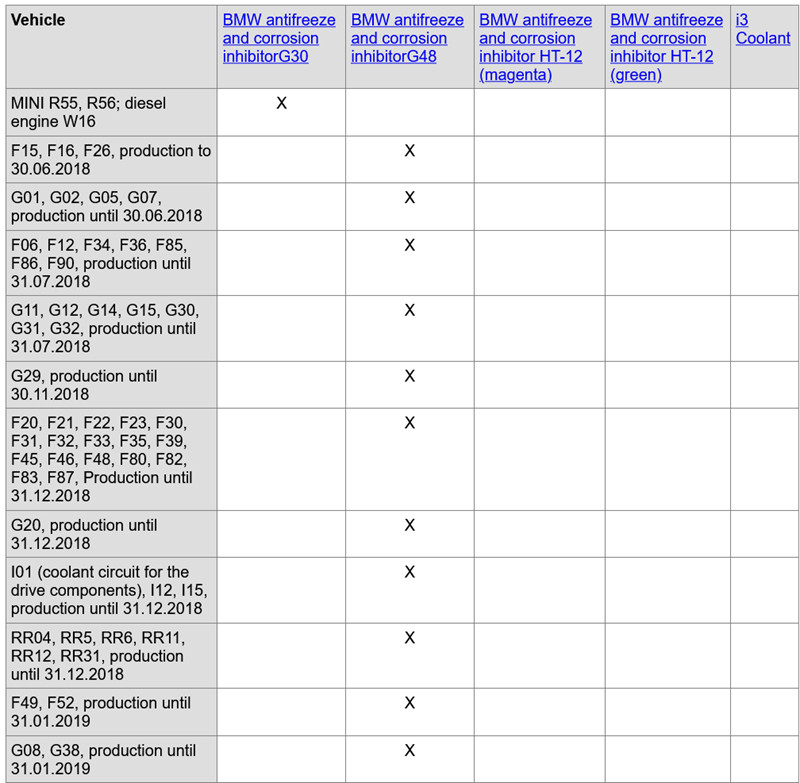
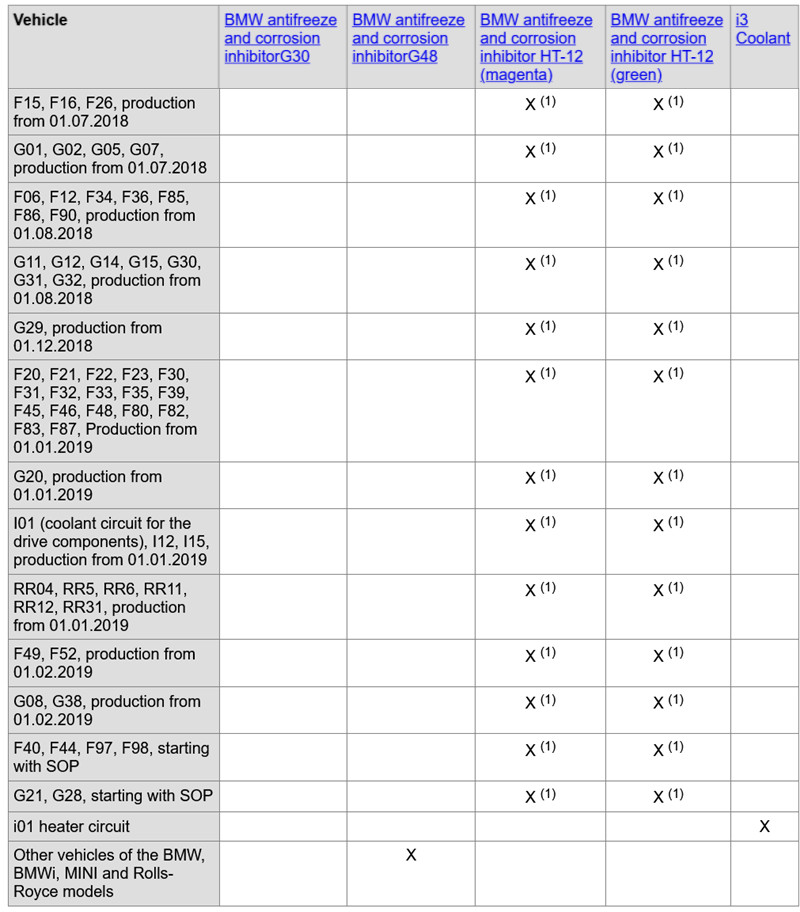
Here's a breakdown of what gets used where. I copied the post into my vehicle onenote info. There is actually a magenta and green HT-12.
https://x3.xbimmers.com/forums/showpost.php?p=30170168&postcount=16
https://x3.xbimmers.com/forums/showpost.php?p=30170168&postcount=16
09-26-2025
09-26-2025

Beemertechnik
306
REP
345
POSTS
it is my understanding that BMW utilizes the green coolant on the low pressure cooling system from factory to be able to easily
differentiate between the low pressure and high presssure cooling systems when checking for leaks at the factory.
i’m told they are the same exact coolant, same formula, just different colors to isolate the two systems when testing.
it will NOT hurt the cooling system when switching over or topping off with the blue BMW coolant
differentiate between the low pressure and high presssure cooling systems when checking for leaks at the factory.
i’m told they are the same exact coolant, same formula, just different colors to isolate the two systems when testing.
it will NOT hurt the cooling system when switching over or topping off with the blue BMW coolant
09-26-2025
09-26-2025

Wgosma
Colonel
1,075
REP
2.2K
POSTS
Beemertechnik wroteThat is interesting and makes sense…what is your source of this info?it is my understanding that BMW utilizes the green coolant on the low pressure cooling system from factory to be able to easily
differentiate between the low pressure and high presssure cooling systems when checking for leaks at the factory.
i’m told they are the same exact coolant, same formula, just different colors to isolate the two systems when testing.
it will NOT hurt the cooling system when switching over or topping off with the blue BMW coolant
09-26-2025
09-26-2025
Beemertechnik
306
REP
345
POSTS
Wgosma wrotei believe i heard this from two sources at the time-my shop foreman from when i worked at a BMW dealership and also the N63 engine introductory class which was one of the first engines to utilize auxiliary water pump for turbocharging cooling.That is interesting and makes sense…what is your source of this info?
in fact, i remember some of the early N63s having a blue-pinkish hue color back when replacing the early auxiliary water pumps when they would fail.
We were always given the traditional Blue coolant to top off (G48)
Wgosma
09-26-2025
09-26-2025
This is more technical information on the 2. You shouldn't replace the HT12 with G48, but you can replace G48 with HT12 (due to additives and system designs, backwards compatible doesn't mean forwards compatible as a general rule). They are different but somewhat compatible - https://www.fcpeuro.com/blog/how-to-pick-the-right-coolant-for-your-car
Hybrid Organic Acid Technology (HOAT)
HOAT is a term that combines IAT technologies and OAT technologies together. Generally designed for engines that have iron blocks and aluminum heads, most modern coolants for European cars are created with this technology. The European formulas do not contain any phosphates either, as they do not work well with the hard water found in Europe.
Common HOAT Coolant Formulas:
G48 (Also known as VW G11)
VAG (VW, Audi, Seat, Skoda): TL 774-C
BMW: LC-87
Mercedes-Benz: DBL 7700.20
Opel/General Motors: B 040 0240
Porsche: TL 774-C
Saab: 6901599
Silicate Organic Acid Technology (Si-OAT)
Performance issues with silicate-free OAT led to the development of a new high-performance antifreeze/coolant technology called Si-OAT (Silicate Organic Additive Technology). Basically, this coolant is the best of both worlds—great protection with silicates being re-introduced and longer life with OAT technology. These new Si-OAT products are backward compatible as well.
Thermostat-Housing-electrolysis
Common Si-OAT Coolant Formulas:
HT12
BMW: LC-18
Engine Coolant Compatibility
One of the easier rules to remember is that you can not mix IAT and OAT coolants; OATs should stay OAT only, and IAT needs to stay exclusively IAT. You can, however, top off with the correct fluid rated for your car regardless of the color it is produced in; dyes don't matter in this case, though they will change the color. You can also mix Si-OAT fluids with previous generations of fluids as they are backward compatible.
Hybrid Organic Acid Technology (HOAT)
HOAT is a term that combines IAT technologies and OAT technologies together. Generally designed for engines that have iron blocks and aluminum heads, most modern coolants for European cars are created with this technology. The European formulas do not contain any phosphates either, as they do not work well with the hard water found in Europe.
Common HOAT Coolant Formulas:
G48 (Also known as VW G11)
VAG (VW, Audi, Seat, Skoda): TL 774-C
BMW: LC-87
Mercedes-Benz: DBL 7700.20
Opel/General Motors: B 040 0240
Porsche: TL 774-C
Saab: 6901599
Silicate Organic Acid Technology (Si-OAT)
Performance issues with silicate-free OAT led to the development of a new high-performance antifreeze/coolant technology called Si-OAT (Silicate Organic Additive Technology). Basically, this coolant is the best of both worlds—great protection with silicates being re-introduced and longer life with OAT technology. These new Si-OAT products are backward compatible as well.
Thermostat-Housing-electrolysis
Common Si-OAT Coolant Formulas:
HT12
BMW: LC-18
Engine Coolant Compatibility
One of the easier rules to remember is that you can not mix IAT and OAT coolants; OATs should stay OAT only, and IAT needs to stay exclusively IAT. You can, however, top off with the correct fluid rated for your car regardless of the color it is produced in; dyes don't matter in this case, though they will change the color. You can also mix Si-OAT fluids with previous generations of fluids as they are backward compatible.

Wgosma
,
Mondomensch
09-26-2025
09-26-2025

For clarification, on next coolant flush we can revert back to G48 (Blue) instead of using HT12 (Green) by draining completely? But in the meantime, we cannot add the Blue to the Green when coolant gets low? BTW, the heck with the environmental friendly thing.
09-26-2025
09-26-2025

Qsilver7
Major General
6,502
REP
9.8K
POSTS
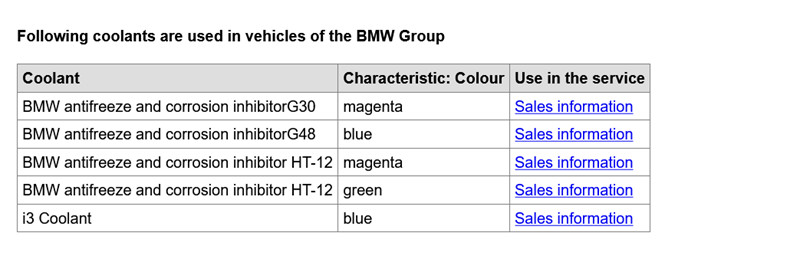
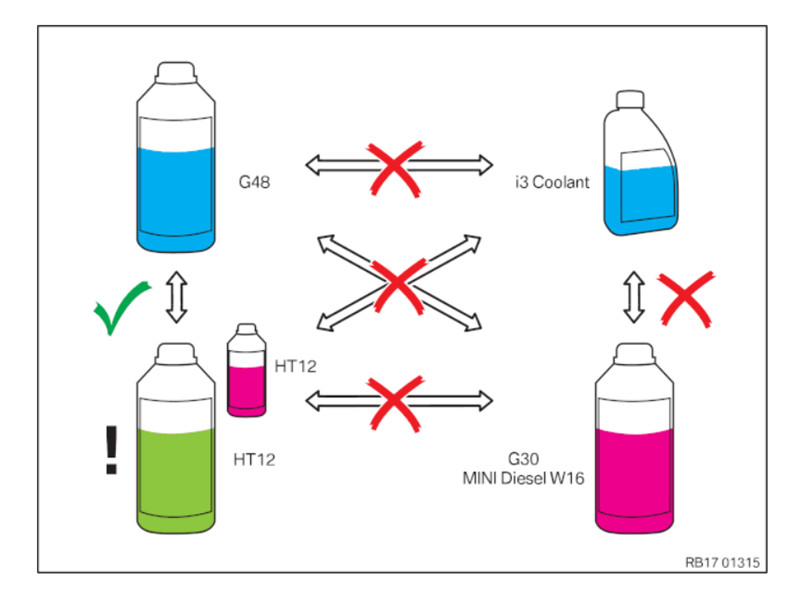
Yes, you can MIX the g48 & ht-12…at least it is listed that way in BMW documentation. If you stay with the formulation (G48 and HT-12) they can be mixed. If you ‘re going by color alone…then you may get into issues since some non compatible blue coolant (i3) is NOT compatible, and neither is some magenta colored coolant (G30 for the MINI).
If some dealerships are putting G48 in the low pressure system and HT-12 in the high pressure system…that is something they are doing on their own. From the factory since 2018…BMW is using the green HT-12 (for a short period there was magenta colored HT-12.
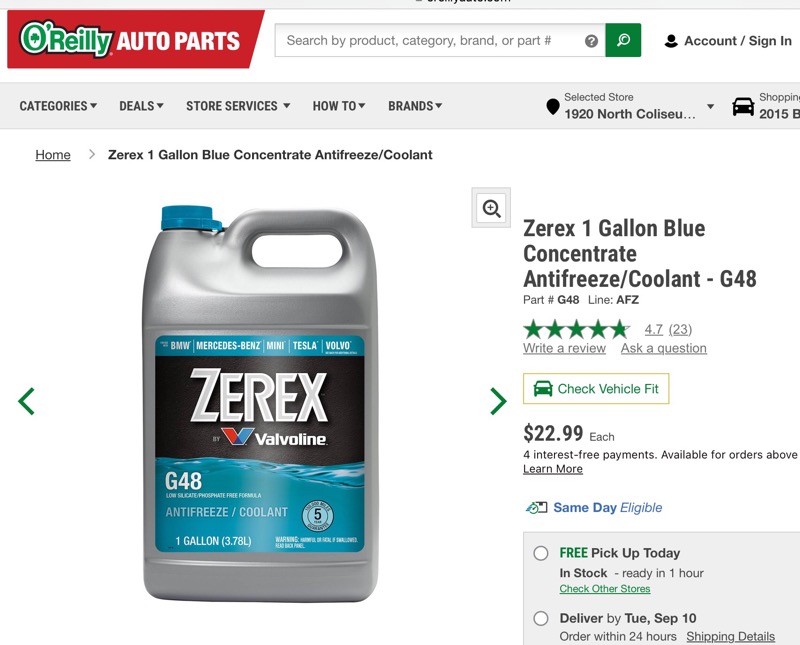
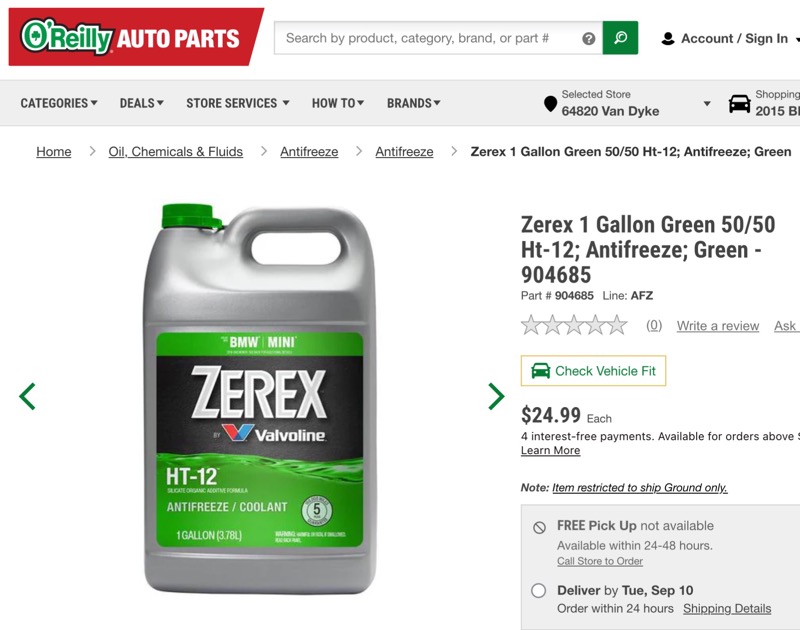
Also, there are compatible aftermarket HT-12 & G48 coolant…Zerex sells it.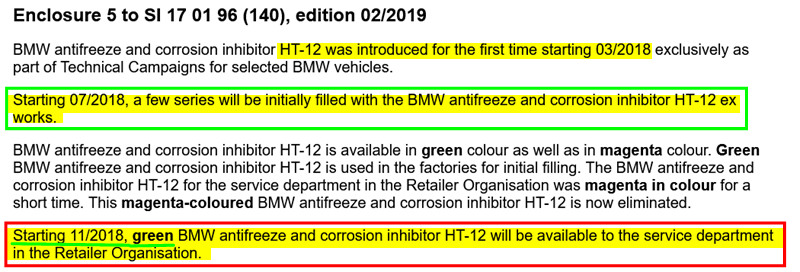
If some dealerships are putting G48 in the low pressure system and HT-12 in the high pressure system…that is something they are doing on their own. From the factory since 2018…BMW is using the green HT-12 (for a short period there was magenta colored HT-12.
Also, there are compatible aftermarket HT-12 & G48 coolant…Zerex sells it.

Wgosma
,
admranger
09-28-2025
09-28-2025

Very interesting thread!
10-19-2025
10-19-2025

Hi. My car is a MY 2019 G01. I can't tell what coolant color it has (blue or green). I've had four people look at it two say blue and two say green. If the cut off date is June 28 G48 blue/July 1 2018 HT-12 green and I'm assuming they were making MY 2019 G01s at thst time, how can I tell what my car came with in order add the correct fluid?
10-20-2025
10-20-2025
Thank you. I found the production date on the door jam sticker based on information from another thread which shows my car as produced on 8/18 and should have green HT-12.
