This article is worth the read
The political shift that will determine F1's next engine formula
https://www.autosport.com/f1/news/th...mula/10813180/
In an exclusive interview with Autosport this week, F1 CEO Stefano Domenicali stated that the fundamentals of the next engine formula, due to come into effect in 2031, need to be agreed by the end of this year. The subtext of this - not that he said it explicitly - is that settling early on a technical philosophy with defined, foreseeable, agreed and attainable goals will avoid a repeat of the present state of affairs, where a formula has come into effect while still in the beta testing phase.
So how did we get here? The near-50/50 split was agreed as long ago as August 2022, in a meeting of the FIA's World Motor Sport Council, where it was also agreed that F1 would shift to 100% sustainable fuel and drop the much-disliked MGU-H hybrid element from the power unit package.
When these policies were rubber-stamped, F1's stakeholders were understandably keen to keep the power unit manufacturers engaged – and potentially attract new ones – by following the wider automotive industry's direction of travel. At the time this was very much towards full electrification, given impending legislation against the sale of internal combustion-powered cars in many key markets.
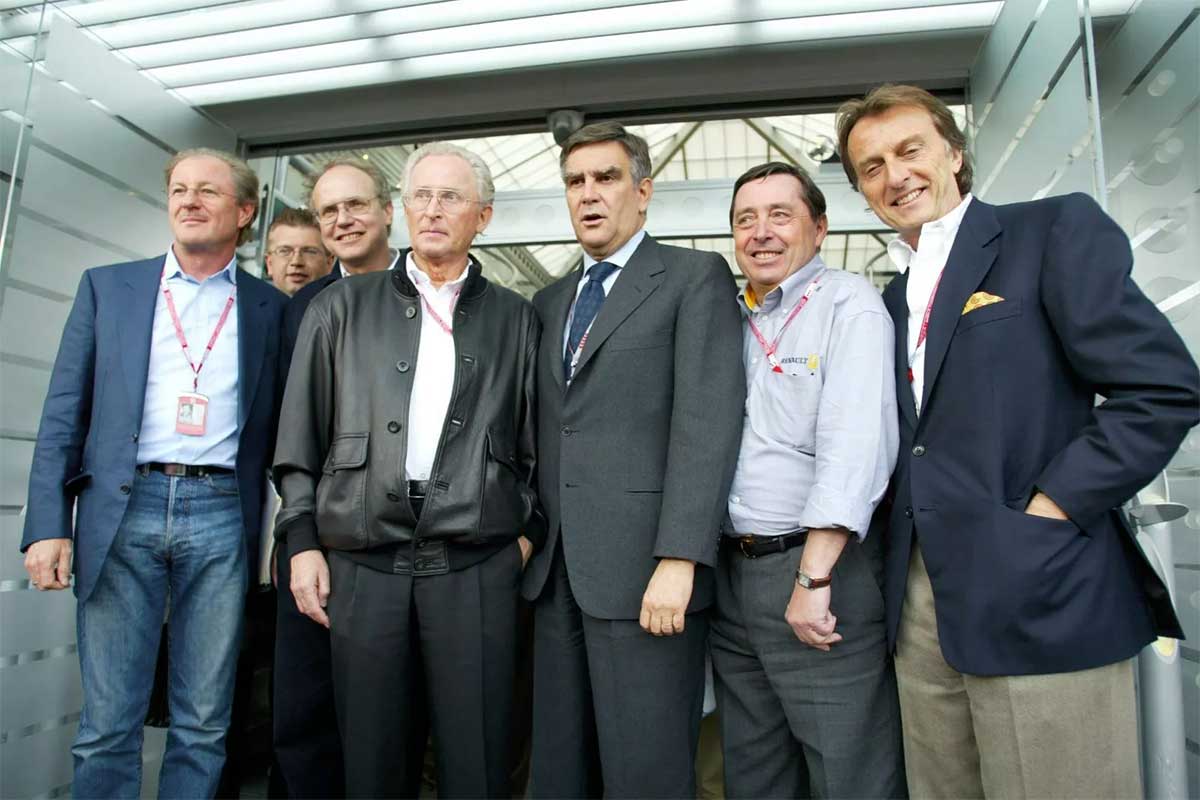
Meet the bosses: Wolfgang Reitzle (Jaguar/Ford), Burkhard Goeschel (BMW), Juergen Hubbert (Mercedes), Paulo Cantarella (Fiat), Patrick Faure (Renault) and Luca di Montezemolo (Ferrari) gather in McLaren's motorhome at the 2002 San Marino GP to discuss their proposed breakaway series, the Grand Prix World Championship.